Skip to content
New 2026 Offensive Security Cohort Enrolling Now
devwalls security

books & technical guides

Comprehensive field guides, adversary tradecraft manuals, and architecture blueprints for security practitioners, developers, and technology executives.

Publishing Division
Devwalls Press

Offensive engineering field manuals

Focus
Offensive & Cloud

Real-world exploit chains & remediation

Distribution
Free Technical Guides

Direct PDF download or web access

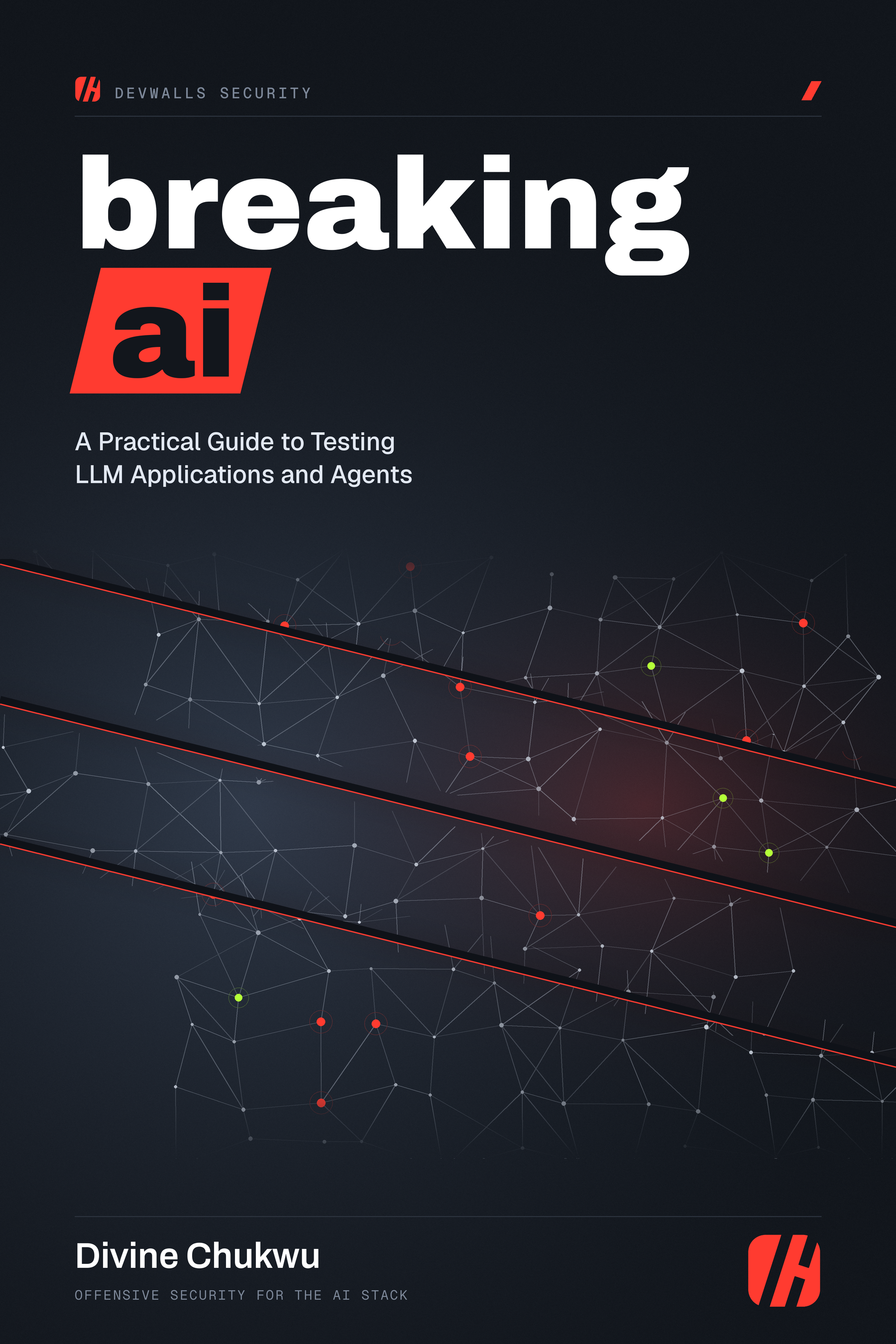
Breaking AI: A Practical Guide to Testing LLM Applications and Agents
PDF & eBook · by Divine Chukwu

Breaking AI: A Practical Guide to Testing LLM Applications and Agents

Breaking AI: A Practical Guide to Testing LLM Applications and Agents is a comprehensive, hands-on guide to understanding and securing the rapidly evolving world of artificial intelligence.

Written by Divine Chukwu, this book takes security professionals, penetration testers, developers, and AI enthusiasts beyond the chatbot interface to explore how modern AI systems are actually built, where they fail, and how to test them responsibly. You'll learn how to assess prompt injection, system prompt exposure, guardrail weaknesses, RAG and retrieval attacks, vector database security, cross-tenant failures, AI memory risks, tool and function-calling abuse, excessive agency, autonomous agents, multi-agent systems, sandbox escapes, and supply-chain risks. The book also provides a practical methodology for conducting professional AI security assessments—from scoping and threat modelling to testing, evidence collection, and writing security reports. With a dedicated AI Test-Case Library, Engagement Checklist, Sample Reports, and Glossary, Breaking AI gives you a structured foundation for entering the growing field of AI security and AI red teaming. AI security is not just about the model. It's about the prompts, data, tools, agents, integrations, and systems that trust its output. This book teaches you how to test the entire AI stack. By Divine Chukwu | Devwalls Security — Offensive Security for the AI Stack
Instant digital delivery · Clean PDF & eBook format
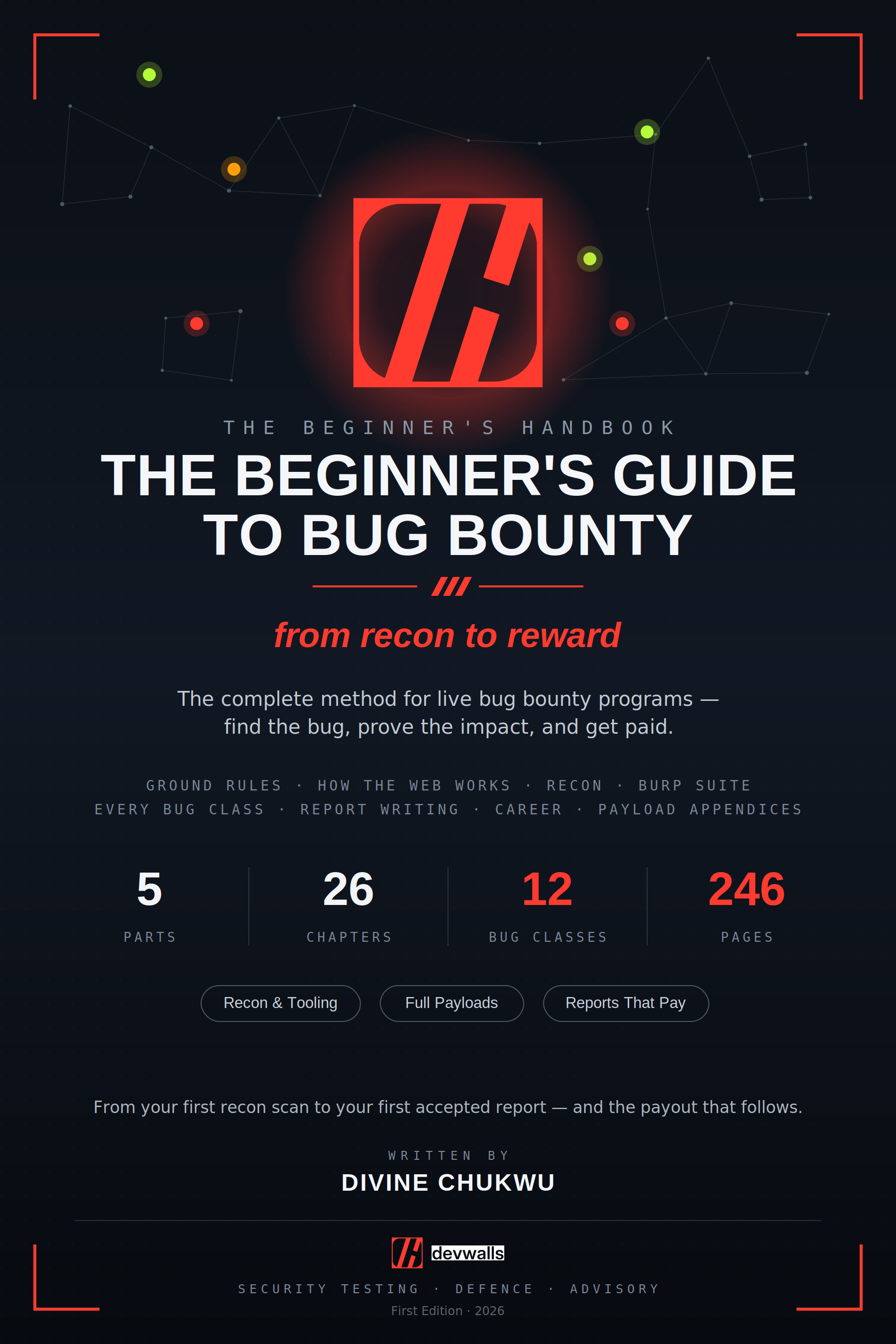
The Beginner's Guide to Bug Bounty
PDF & eBook · 246 pages · by Divine Chukwu

The Beginner's Guide to Bug Bounty

Most people who try bug bounty quit within three months — not because they can't find bugs, but because nobody taught them where to look, how to prove impact without crossing a line, or how to write the report that turns a finding into a payout.

Written by Divine Chukwu and published by Devwalls Security, this 246-page handbook takes you from zero knowledge to your first accepted report. No prior hacking experience required — just the willingness to work through it. Inside, you'll learn: The honest economics of bug bounty — what beginners really earn, and how to pick unglamorous, under-tested programs where you can actually compete The legal ground rules — authorization, scope, and safe harbour across Nigeria, the UK, the US, and the EU, so you never put yourself at risk How the web really works — HTTP, sessions, and the browser security model that every vulnerability exploits A full recon and tooling workflow — Burp Suite from zero, subdomain enumeration, content discovery, and reading JavaScript to map an application Every major vulnerability class, with real payloads and step-by-step exploitation — access control & IDOR, XSS, SQL and other injection, SSRF, CSRF & CORS, authentication and JWT flaws, business logic and file upload, information disclosure, open redirects, path traversal, subdomain takeover, API & GraphQL testing, and race conditions The skill that actually pays — writing reports triagers accept on the first read, handling duplicates and rejections professionally, and climbing toward private, less-crowded programs A sustainable path — building a portfolio, reputation, and a real career in security Plus four practical appendices: a payload & command quick-reference, a printable per-target methodology checklist, a full glossary, and three complete worked sample reports you can model your own on. Every technique is taught the ethical way — prove, don't breach; use your own accounts; keep your proof-of-concepts harmless — because your reputation is the asset that pays you for years. What you get: 246 pages · 5 parts · 26 chapters · 12 vulnerability classes · 4 reference appendices. If you're serious about learning bug bounty properly — and getting paid for it — start here.
Instant digital delivery · Clean PDF & eBook format
Modern Ethical Hacking & Penetration Testing with Artificial Intelligence — A Practitioner's Handbook
PDF & eBook · by Divine Chukwu

Modern Ethical Hacking & Penetration Testing with Artificial Intelligence — A Practitioner's Handbook

Nothing generated by an AI model reaches a client, a live target, or a security report until it has been independently verified against evidence outside the model.

AI can scan a network in seconds, draft an exploit concept, analyze massive logs, and accelerate security research before you've finished your coffee. It can also hallucinate a CVE, miss a critical business-logic flaw, and lead an autonomous agent straight out of scope — all while sounding completely confident. Most security content picks a side: either "AI will replace penetration testers" hype or "ignore AI and do it properly" gatekeeping. Neither approach is useful on a real engagement. Modern Ethical Hacking & Penetration Testing with Artificial Intelligence, written by Divine Chukwu, is the practical handbook for security professionals who need both speed and judgment on the same engagement. Drawing from the perspective of a software security architect, cybersecurity professional, and practitioner working at the intersection of offensive security and artificial intelligence, Divine presents a structured approach to using AI as a security testing accelerator — without allowing it to replace human verification, professional judgment, or ethical responsibility. What's inside Part I — Ground Rules Authorization, scope, contracts, ethical responsibilities, and the data-discipline rules that keep sensitive client information out of the wrong AI model. Part II — The AI-Augmented Engagement The complete penetration-testing lifecycle — from reconnaissance and enumeration to exploitation and reporting — with AI placed exactly where it provides value and clearly restricted where it does not. Part III — Prompt Engineering for Security Work A reusable security prompt library and a verification discipline designed to catch hallucinated findings before they reach a client. Part IV — Building Your AI Security Toolchain Local vs. hosted models, secure AI workflows, automation pipelines, and practical guardrails for autonomous security agents. Part V — Testing AI Systems Themselves The OWASP LLM Top 10 in practice, AI red-teaming methodology, prompt injection testing, and a complete worked engagement involving an AI security weakness and real-world business impact. Part VI — Reference Playbooks Practical web, API, network, cloud, and AI testing checklists designed for real engagements. Part VII — Practice, Proof & Career A structured 12-week study path, bug bounty strategy, portfolio development, and guidance for building a career in the rapidly growing AI security field. Part VIII — The Lab Workbook 18 guided and progressively challenging labs — from your first security testing environment to a complete self-directed mock engagement. Appendices A–I A signable Rules of Engagement template, AI usage policy, pre-engagement checklists, reference materials, and complete sample findings written to professional client standards. The principle behind the entire book Every technique in this handbook follows one fundamental rule: Nothing generated by an AI model reaches a client, a live target, or a security report until it has been independently verified against evidence outside the model. That is the difference between a security professional using AI intelligently and someone quietly laundering a language model's guesses into a security engagement. Whether you're beginning your cybersecurity journey, following the twelve-week learning path, working as a penetration tester, or looking to specialize in the emerging field of AI security and AI red teaming, this handbook gives you a practical framework for working faster without compromising accuracy, safety, or professional standards.

Instant digital delivery · Clean PDF & eBook format
Start a Conversation

Need tailored security training for your team?

A twenty-minute call is usually enough to tell whether we are the right fit. If we are not, we will say so.